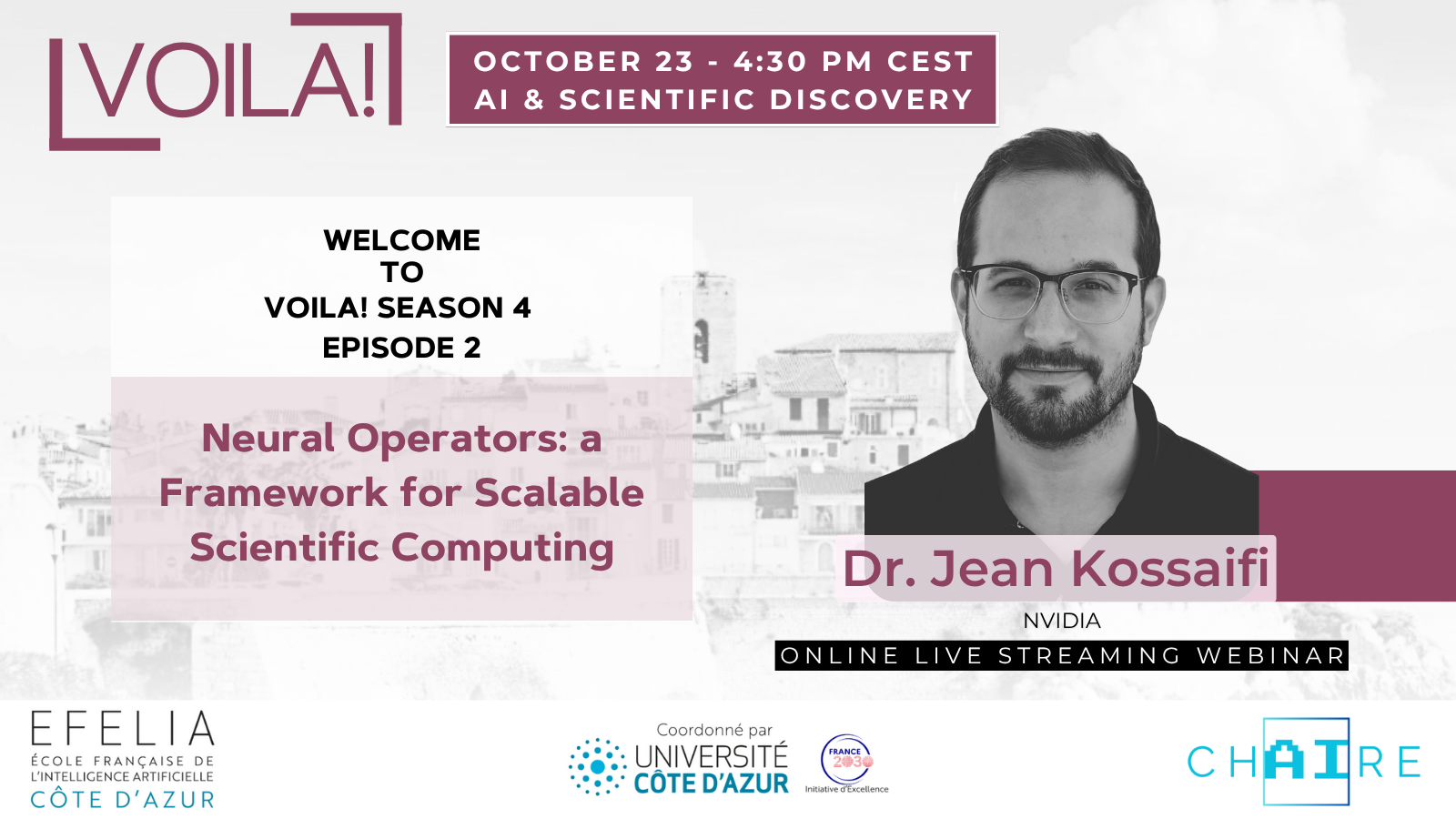
Dr. Jean Kossaifi, NVIDIA
Traditional deep learning typically involves learning mappings between finite-dimensional vector spaces. Scientific and Engineering applications such as weather forecasting and aerodynamics, by contrast, involve modeling complex spatiotemporal processes governed by partial differential equations (PDEs) defined on continuous domains and at multiple scales. In other words, they involve learning mappings between infinite-dimensional function spaces.
Neural operators enable this by generalizing deep learning to learn mappings directly between function spaces, while offering substantial speed improvements over traditional PDE solvers, often several orders of magnitude faster. In this talk, I will introduce the fundamental concepts behind neural operators, illustrate their effectiveness on practical problems such as weather forecasting. Finally, I will touch on computational efficiency and practical implementation aspects in Python, demonstrating how these concepts can be applied in practice using open-source software.
Neural operators enable this by generalizing deep learning to learn mappings directly between function spaces, while offering substantial speed improvements over traditional PDE solvers, often several orders of magnitude faster. In this talk, I will introduce the fundamental concepts behind neural operators, illustrate their effectiveness on practical problems such as weather forecasting. Finally, I will touch on computational efficiency and practical implementation aspects in Python, demonstrating how these concepts can be applied in practice using open-source software.